


Formal Opposition to S.4489 and Companion House Bill H.R.8745
Protect Montana’s Wells and Water Rights~ Learn About
Water-Wealth Transfer and Why We Oppose the DRWA Bill.
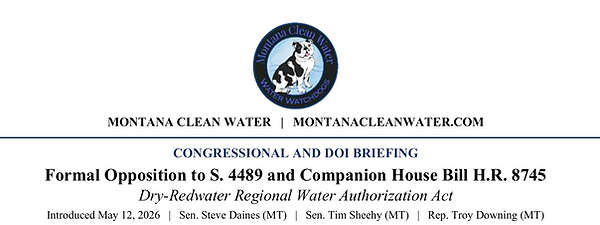
Click on the
Blue Button Below to Read Opposition Letter to Congress
Read supporting domumentation for Formal Opposition Letter here.
DRWA Petition
Read our Petition to Government asking
-
A comprehensive federal audit of the DRWA’s financial activities from 2005 to the present.
-
A fair and transparent assessment of actual water needs in Eastern Montana before any additional federal funding is awarded to the DRWA
-
Accurate, science-based hydrogeological studies to be completed by the DNRC prior to decisions that affect private wells and aquifers.
-
Strong accountability measures that hold government agencies responsible for actions that compromise property rights, endanger natural resources, or threaten the independence of rural communities.


ALL ABOUT
Dry Redwater
(DRWA)
Read the Stantec Memo
What the Stantec Addendum Tries to Say
Stantec's own December 2025 estimate finds that households in the DRWA service area currently spend just 1.76% of their discretionary income on water, already close to the Bureau of Reclamation's affordability threshold of about 1.97%. To make the project look necessary, the memo raises that burden to 4.9% by adding costs for "mitigating behaviors" it assumes households may use: bottled water, whole-home reverse osmosis systems, water softeners, and replacing fixtures and appliances twice as often. The largest of these is brine disposal, estimated at $87,000 to $225,000 per connection, based on the assumption that each home using RO will build a $29,000–$75,000 sand mound or brine lagoon and replace it every 20 years.
Those hypothetical expenses are then counted as "savings" DRWA would deliver.
These assumptions are applied across the entire service area, even though the memo acknowledges that the worst water problems are in the west and that the east, home to about 87% of the population, has much better water. The project also doesn't include water softening, even though Fort Peck Lake water is classified as very hard, yet hard-water damage is still counted as a benefit. Stantec even admits some households could pay more under the project. This 40-page memo is essentially a condensed version of Appendix D, where some form of the word "assume" appears 215 times. To assume means to suppose something is true without proof. We encourage you to read the document yourself and decide.
The REAL Cost of DRWA
Real Estimated Construction Cost over the next 10 years: (adding up Line 3)
$1,009,013,646.78
10-Year Build-Out (in 2026 dollars):
$891,957,210.32 (Line 4)
The cost of DRWA — for just a few hookups — is already projected to exceed $1 billion. They've framed the cost in "2026 dollars," but with inflation and interest, the true price will be even higher.
Find these numbers on page 15 of DRWA Predesign Report 2023


How Many Connections Does Dry-Redwater (DRWA) Really Have?
How Many DRWA Connections Are Actually Committed?
DRWA is telling Congress it will serve more than 4,000 connections. Its own documents show those numbers are based on proximity, not commitment. Every house within reach was counted.
The 2025 Feasibility Report explains:"The rural residential connections were determined by including every existing house that could be reached by adding 1.5 miles of a distribution branch to the main stem pipe alignment as a residential connection."
The 2023 Predesign Report calls the model "100% saturated, meaning every existing house that met the 1 ½ miles criteria are added," and admits that for pasture taps, "the location is unknown at the feasibility level."
DRWA has counted every house within 1.5 miles of its pipeline since at least the 2023 Predesign Report. Even with every one of those homes assumed to connect, the project still fell short. In January 2025, DRWA Coordinator Mandi Nay wrote to the board:
"Our biggest issue is we just do not have the population to make our NED 1:1 or better... DRWA would need an additional 360–1,500 connections to close the NED gap."
She added that Stantec was "working on finding justification to make adjustments to the estimated population growth over the 50-year project period."
In other words, after assuming 100% of nearby homes would sign on, DRWA still needed hundreds more connections to make the project pencil out, so the plan was to find justification for more.
Why the number matters
The connection count drives nearly every benefit DRWA claims. The assumed costs of bottled water, reverse osmosis systems, brine disposal, and hard-water damage are multiplied across every projected connection. Each house counted simply because it sits near a pipeline adds to the project's claimed benefits, whether or not anyone living there has agreed to connect. Inflate the number of connections, and you inflate the benefits used to argue the project is feasible.
A sign-up is not a commitment
DRWA's own regulations define a Good Intention Fee as simply "a fee expressing an individual's intention to become a DRWA user."
Many of these fees were paid 20 years ago. Our review of DRWA's 2012 participant list found 702 paid entries, including 114 pasture taps and about 119 duplicate names and addresses, along with cabins and recreational properties. Together, pasture taps and duplicates make up roughly one-third of the list. Some who signed up have since moved away, and others have told us they no longer want DRWA water.
Would they have signed up if they'd known the cost?
"DRWA indicated that new connections are charged a $5,000 connection fee per equivalent dwelling unit (EDU)." (2025 Final Feasibility Study)
"Any Standard/Commercial User DRWA User Agreement will remain in effect, and service shall be paid, for a minimum of 20 years, even during periods when the service is not in use." (DRWA Regulations for Rural Users)
The same 20-year requirement applies to livestock, pasture, and seasonal users. DRWA also requires easements across private property and charges a monthly base rate on top of water use. Even a signed agreement doesn't guarantee a customer. DRWA's own April 2025 records note a user who "has signed a User Agreement" but "declined service when DRWA followed up."
These Numbers Don't Reflect Reality
A house within 1.5 miles of a pipeline is not a customer. A $100 fee paid 20 years ago, before established hookup fees, base rates, usage charges, easements, or a decades-long service commitment, is not a guaranteed connection. And when ranchers learn that DRWA expects a $5,000 fee for each pasture tap, and that watering 200 head of cattle could cost an estimated $13,000 a year at DRWA's current rates (based on a local rancher's calculation), will they still want DRWA? A pasture tap, cabin, or duplicate entry is not a household in need of water. DRWA's documents do not show anywhere near 4,348 committed customers. They show a projection built on faulty assumptions, and that projection is what's being presented to Congress.
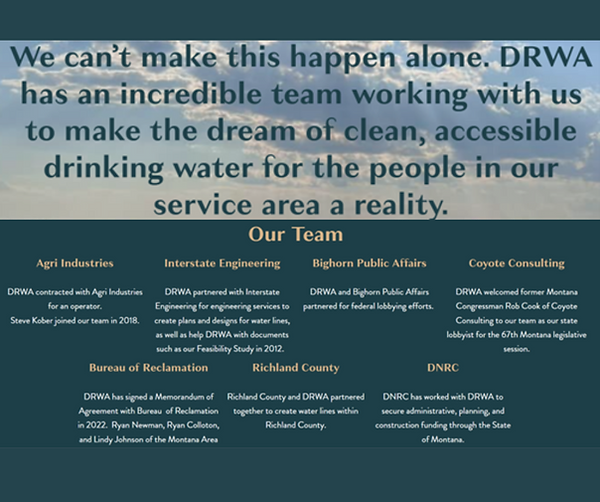
The Dry-Redwater (DRWA) "TEAM"
Montana DNRC ~ Richland County ~ AGRI
Screenshot from DRWA Website
Highlights From Dry-Redwater
Predesign Report 2023

“A Good Intention Fee of $100 was paid by interested landowners and public water suppliers to show their commitment to a rural water system. DRWA collected $73,525 to-date.” Pg. 17,18
“Phases were established using a combination of cost estimates for each line number, pipeline lengths and quantity of residential users. Phases were organized to capture the bulk of revenue from the project’s bulk users in the first years of the project to cover OM&R costs and provide coverage for construction loans.” Pg.9
“DRWA was encouraged by DNRC to continue progress on this project knowing that federal authorization would be likely. DNRC recommended to DRWA they use DNRC funding for this Predesign Report. This PDR answers most of the DEC report’s Findings and Recommendations.” Pg. 18
“There are approximately 1,564 (in 2020) rural homes that will be served by DRWA. The towns of Circle (2020 population 511), Fairview (2020 population 898), Richey (2020 population 167), Lambert (2020 population 84) and Jordan (2020 population 412) will receive water from DRWA. These towns will be responsible for continuing to maintain their municipal water systems and delivering water to their users. DRWA will deliver water to each town’s tank.” Pg. 19
“The number of pasture taps were determined by multiplying the residential meters by 30%.” Pg.44
“The 2022 water model is 100% saturated, meaning every existing house that met the 1 ½ miles criteria are added to the water model. The general rule for a rural water model is 80% saturation, i.e., 8 out of 10 homes will connect.” Pg. 44
“…none of DRWA’s tanks will include additional storage for municipal fire flow requirements.” Pg. 44
“….aerial photography were used to locate every existing home in DRWA’s service area.” Pg.43
“The 2022 water model is 100% saturated, meaning every existing house that met the 1 ½ miles criteria are added to the water model. The general rule for a rural water model is 80% saturation, i.e., 8 out of 10 homes will connect. Therefore, the 2022 water model which is 100% saturated is equal to 80% saturation in year 2040 with population increases and new home construction.” Pg. 44
“The Fort Peck Water Treatment Plant will use chloramines for disinfection since they tend to remain active for longer periods and at greater distances from the plant than free chlorine. Chloramines are disinfectants used to treat drinking water. Chloramines are most commonly formed when ammonia is added to chlorine to treat drinking water and they provide longer-lasting disinfection as the water moves through pipes to consumers. This type of disinfection is known as secondary disinfection. EPA requires water utilities to meet strict health standards when using chloramines to treat water. The regulations are based on the average concentration of chloramines found in a water system over time.” Pg. 115
“Per Circular DEQ 1, chloramine concentrations should be maintained higher than chlorine to avoid nitrifying bacterial activity.” Pg.115
“A note of caution regarding chloramines is kidney dialysis treatment which can be upset by the use of chloraminated water. Medical authorities, hospitals, and aquarium keepers should be notified of chloramine disinfection if these businesses connect to DRWA so they can take precautions.” Pg. 117
“DRWA will be requesting a deviation from DEQ-1, Section 8.5.1 for valves to change requirements from ALL high points to needed high points. For this PDR, air/vac valve spacing is every 4 miles.” Pg. 118
“Advanced Metering Infrastructure Advanced Metering Infrastructure (AMI) provides consistent two-way communication between customers and the utility that gives both parties real-time data. AMI water meters have the capability to send water use data over a communications network.” Pg.118
“…the meters are read once every 15 minutes for a total of 96 readings every day.” Pg.118
“Smart meters allow the customer to make resourceful decisions to save money such as managing decisions about service and usage, examples being cost and consumption.” Pg. 118
“Using AMI smart meters, the utility or customer can go to a network and observe in real time how the water is being used and where, without having to go anywhere.” Pg. 118
“The Project will supply safe and reliable drinking water to 4,403 rural and municipal connections within DRWA’s service area.” Pg. 149
“The cost per rural and municipal connection is $171,165.12/connection. The worth of this Project is increased dramatically when factoring in pasture taps and the increase in livestock production which benefits the nation as a whole. Reclamation is performing the economic analysis of the Project during the feasibility study.” Pg. 149
“The Phasing Plan is not only used to plan construction of the Project but also used to lobby the federal, state, and local funding needed ahead of design and construction activities.” Pg.149
“Phases were organized to capture the bulk of revenue from the Project’s bulk users in the first years of the Project to cover OM&R costs and provide coverage for construction loans. After all bulk users are connected, prioritization of the Phases shifted to those rural reaches with the greatest quantity of residential meters through Project completion.” Pg. 150
“Construction of the Project will take more than 10 years should federal funding not be made available in accordance with the Phase Plan and in a timely matter.” Pg. 152
“A Notice to Proceed is planned to be issued for the Project in 2026.” Pg. 152
DRWA
Meeting Minutes
February 19, 2025
Highway 200 West: Construction of Highway 200 West will be in two phases. Phase I was sent to Montana DEQ for approval, and the project will be bid out in March, with construction beginning in Spring 2025. Highway 200 West will consist of total 7.2 miles of main, 6.8 miles of distribution, and 2 miles of service line. The extension includes a total of 64 connections.
DNRC: Rick Duncan/DNRC was in attendance. Despite the lack of funding, work is still being completed on the Feasibility Study as DRWA Authorization expires in December 2025.
DNRC and Richland County ARPA funding is contracted and available for draw for construction on Highway 200 West.
The Financial Agreement and associated funds are currently affected by the temporary federal funding freeze with the new Administration. All work must be completed by December of 2025 when DRWA’s Authorization expires.
ARPA Funding Update: ARPA Funds are will be drawn from soon. DNRC and Richland County ARPA Funding will go towards DRWA’s Highway 200 West Extension, which is to begin construction Spring 2025.
Political Update: Mandi and Emilee traveled to Helena the week of January 20th. During the visit, DRWA testified in front of the Long-Range Planning Committee in support of House Bills 6 and 11. DRWA, along with DRWA Lobbyist Rob Cook, is keeping an eye on HB 2, HB 6, HB 8, and HB 11. DRWA also attended MACD’s Legislative Meet and Greet.
At 2:20 pm,
Dick motioned to adjourn the regular meeting and move into Executive Session. Radley seconded; motion carried.
January 14, 2025
DNRC: Rick Duncan/DNRC was in attendance.
DNRC and Richland County ARPA funding is ready to be drawn for construction on Highway 200 West, with construction beginning Spring 2025.
Bureau of Reclamation: The Financial Agreement funds are expected to be awarded January 31, 2025. All reports must be completed by December of 2025.
December 18, 2024
Highway 200 West: The Highway 200 West Extension is expected to be ready for Spring 2025 construction. During the December Mount Pleasant Subdivision meeting, the subdivision voted no on connection to DRWA.
Bureau of Reclamation:. All information has been provided, but BOR has not yet given an award timeline.
Rules and Regulations. Tom motioned the Board accept the changes to DRWA’s Regulations for Rural Users. Jim seconded; motion carried.
RW-25-092: A grant for construction on Highway 200 W for $3.2 million is almost ready to be executed, pending contract finalization. Mike moved to approve and sign RW-24-092 once the contract is finalized with DNRC. Dick seconded; motion carried.
November 26, 2024
The Draft EA Technical review’s comments are due in December. The economics highlight two methodologies: Benefit/Cost estimates and estimating project alternative costs. The current Benefit And Cost Ration ranges from 0.5-.95. Montana Clean Water note~ this means according to them- the project will being in $0.50 to $0.95 for ever $1.00 spent)
September 25, 2024
Visitors/Public Comments: Charlene Reddig, Constituent Liasson for Steve Daines’ Sidney Office, was in attendance. Charlene spoke with the board about the federal funding process. DRWA’s primary concern at the federal level is currently finalizing the BOR Financial Agreement and receiving funding owed to DRWA
The Feasibility Study and Economic Analysis are needed before DRWA can request federal construction funding.
DRWA is allowed to implement an annual 5% rate increase without public comment. This small annual increase could prevent having to have a large increase in the future. Mike motioned to move forward with DRWA’s allowed Annual 5% Rate Increase for 2025. Monte seconded; motion carried.
July 17, 2024
The Sidney South Extention was Dry-Redwaters's first extention, and was designed and constructed by Richland County and gifted to DRWA.
Highway 200 West: Highway 200 West design currently includes 7 miles of transmission, 4.5 miles of distribution, and 2.5 miles of service main. Phase I will have 13 users connecting. Phase II will connect 46 services, 29 of which are in Schmart Estate Subdivision.
DNRC: Rick Duncan/DNRC was in attendance. State of Montana FY 2024 books are being closed up. Two more quarters from 2024 need to be paid out to DRWA, and will be paid out once FY 2025 opens.
Bureau of Reclamation:
The full $5 million appropriated to DRWA for the
Feasibility Study has been requested
DRWA’s upcoming Feasibility Study.
Town Pump Meter: The Sidney South Extension was Dry-Redwater’s first extension, and was designed and constructed by Richland County and gifted to DRWA.
DNRC: Rick Duncan/DNRC was in attendance. DRWA and DNRC are working together on a one-time grant agreement for administrative funding. Tom motioned to approve and sign RW-24-089. Alan Pluhar seconded; motion carried. The RW-24-089 grant totals $70,000, and will be used for DRWA’s new office space
Willingness To Pay Survey: DRWA has received around 25% of Willingness to Pay Surveys back. Information is being plugged into spreadsheets to be sent to Stantec’s team for analysis.
April 17, 2024
DNRC: Rick Duncan/DNRC was in attendance. Following technical delays, Administrative Grant funding has been received by Dry-Redwater Regional Water Authority for the biennium.
March 13, 2024
Jordan and Mandi will meet with DNRC at Montana Rural Water to discuss project funding.